


TABLE OF CONTENTS
Research on Hunger, Food Security and Sustainable Agriculture
Household Food Security in Rural Bangladesh
Precision Agriculture and Crop Health
Solar Irrigation for Climate-Resilient Farming
Soil and Water Salinity Remediation for Food Security
Biochar and Fertilizer Applications for Sustainable Crop Production
Digital Finance and Smallholder Agricultural Productivity
Artificial Intelligence for Food Waste Management
Healthy, Affordable and Sustainable Food on Campus
Campus Cafeteria and Food Services
Vegetarian, Vegan and Affordable Food Options
Supporting Local and Sustainable Food Producers
Sustainable Procurement and Responsible Food Sourcing
Institutional Support for Students and Staff Experiencing Food Insecurity
Reducing Financial Barriers to Food Security
Knowledge Transfer, Capacity Building and Technology for Farmers and Food Producers
Free Workshops and Access to University Facilities
Knowledge Exchange on Agriculture and Sustainable Development
Supporting Local Products and Digital Innovation in Agribusiness
Connecting Agricultural Research with Policymakers and Public Institutions
Technological Innovation for Seed Quality Assessment
Community Food Security and Humanitarian Assistance Programmes
Emergency Food Assistance During Floods
"Oder Eid, Amader Khushi" ("Their Eid, Our Joy")
Free Meals and Education at Kathpencil Pathshala
Continued Community Food Assistance: Oder Eid, Amader Khushi 2025
Partnerships and Policy Engagement for Food Security and Sustainable Agriculture
National Policy Engagement on Climate-Smart Irrigation
International Commitments and Sustainability Networks
Experiential Learning on Community Food Security
Regional Collaboration on Nutrition and Anemia Prevention
SDG 2: ZERO HUNGER
Research on Hunger, Food Security and Sustainable Agriculture
AIUB advances research addressing key challenges related to food security, agricultural productivity and sustainable food production. Its interdisciplinary research combines economic analysis, engineering innovation and agricultural technologies to explore solutions that improve household access to food, strengthen crop health and optimise food production systems. These contributions support the achievement of SDG 2 by addressing both the socioeconomic conditions influencing food security and the technological opportunities for more productive and resilient agriculture.
Household Food Security in Rural Bangladesh
AIUB researchers investigate the relationship between access to financial resources and household food security, particularly among economically vulnerable rural communities. Their studies examine how microcredit, household assets and financial arrangements influence families' capacity to afford adequate food.
- Microcredit and food security among fish-farming households. A 2022 study co-authored by faculty members from AIUB's Departments of Management and Economics examined the relationship between microcredit and household food expenditure among economically disadvantaged fish farmers with limited access to formal financial services. The findings highlighted the important role of household assets in strengthening families' capacity to allocate resources to food consumption, providing valuable insights for the design of more effective financial interventions addressing rural food insecurity [1].
- Fishery credit and household food expenditure. A 2024 study involving 385 fish farmers in Khulna district examined how access to NGO-provided credit influences household food expenditure. The research identified the value of non-land assets and proximity to NGO branch offices as important factors associated with families' capacity to purchase food. Its findings highlighted the potential of asset-transfer initiatives and accessible village-level financial services to strengthen food security among rural fishing communities [2].
- Loan repayment systems and rural women's food security. Research published in the AIUB Journal of Business and Economics investigated how monthly loan repayment arrangements influence household income and food expenditure among rural women borrowers. This research contributes to understanding how microfinance structures affect women's financial capacity to meet essential household food needs [3]. AIUB also recognises this body of research as part of its institutional contribution to SDG 2 [4].
Precision Agriculture and Crop Health
AIUB strengthens agricultural innovation by developing accessible, non-invasive technologies for crop monitoring, nutrient assessment and disease detection. These research initiatives support more informed crop management, early identification of agricultural problems and the potential improvement of crop productivity.
- Plant phenotyping using electrical impedance tomography. AIUB researchers developed a rapid, cost-effective and high-precision imaging system based on electrical impedance tomography to assess plant characteristics, including growth and development, without damaging the plants. This technology provides an innovative approach to monitoring crop conditions and supporting more effective agricultural management aimed at improving productivity [5].
- Non-invasive crop nutrient assessment. AIUB research has explored electrical impedance spectroscopy (EIS) as a portable and non-invasive method for estimating leaf nitrogen concentrations in canola, wheat, soybean and corn crops [6]. Complementing this work, researchers developed a low-cost EIS sensor integrated with machine learning algorithms to identify phosphorus deficiencies across multiple crops, achieving classification accuracy of up to 95.4% [7]. These technologies facilitate the early identification of nutrient deficiencies, supporting more targeted crop management and the efficient use of agricultural inputs.
- Automated potato disease detection. Recognising the importance of potatoes as a major global food crop, AIUB researchers developed image-processing techniques to identify diseases affecting potato leaves, helping distinguish plant conditions that may be difficult to recognise through visual inspection alone [8]. Further research introduced a deep learning model for potato disease detection, achieving an accuracy of 98.45%. These technological advances support early disease identification and timely crop management, helping farmers protect agricultural production and reduce potential harvest losses [9].
Smart Farming and Aquaculture
AIUB promotes technological innovation in poultry and aquaculture production, two important sources of affordable protein in Bangladesh. Its research explores the integration of the Internet of Things (IoT), sensors, automation, image processing and renewable energy to improve farm monitoring, operational efficiency and resource management.
- IoT-based smart poultry and fish farming. Researchers developed an integrated smart farming system that monitors environmental parameters, including pH, temperature, humidity and dissolved oxygen. The system also incorporates automated environmental regulation, helping farmers maintain suitable production conditions while reducing manual monitoring requirements [10].
- Automated poultry farm management. An IoT-based smart poultry farm design integrates automated feeding, water distribution and egg collection, together with SMS notifications that alert farmers to potential operational risks. This approach supports more efficient farm management and timely responses to changing production conditions [11].
- Smart biofloc aquaculture. AIUB research introduced a smart biofloc fish farming system combining sensors, image processing and solar backup power to monitor water quality and fish growth. The system provides a cost-effective technological approach to managing aquaculture conditions and supporting more efficient fish production [12].
- Solar-powered automated fish feeding. An IoT-based automated fish feeding system powered by solar energy enables farmers to remotely control feeding operations using a mobile phone. This solution facilitates consistent feeding schedules, reduces manual labour and combines digital technologies with renewable energy to support more efficient aquaculture management [13].
Solar Irrigation for Climate-Resilient Farming
AIUB contributes to international collaborative research on promoting solar-powered irrigation as a sustainable alternative for agricultural water management. The university participates in a research consortium supported by the World Bank, with the Asian Disaster Preparedness Center (ADPC) facilitating the initiative. Led by Durham University (United Kingdom), the consortium also involves Curtin University (Australia), the University of Rajshahi and Khulna University [14]–[19].
The collaboration focuses on developing a behavioural toolkit to encourage farmers to adopt solar irrigation technologies. By promoting the adoption of renewable-energy-based irrigation, the initiative supports more sustainable agricultural practices, offers opportunities to reduce dependence on conventional energy sources and strengthens farming communities' capacity to adapt to climate-related challenges. These efforts contribute to more resilient agricultural production and the long-term sustainability of food systems.
AIUB further extends the value of its research collaborations by engaging with policymakers and relevant stakeholders to promote the application of research findings in agricultural development and sustainability initiatives (see Section 7).
Soil and Water Salinity Remediation for Food Security
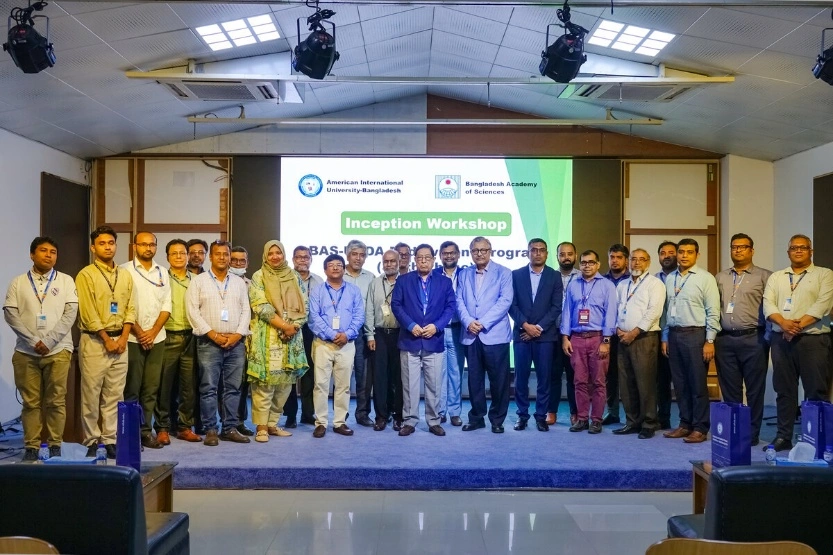
AIUB strengthens agricultural research through innovative nanotechnology solutions addressing environmental constraints that affect food production. In 2025, AIUB faculty secured a research grant under the BAS-USDA Endowment Program for a three-year project (2025–2028) entitled "Desalination of Water and Soil Using Nanomaterials and Nanotechnology" [15].
Led by Dr. Mohammad Mahbub Rabbani, Associate Professor in the Department of Chemistry and In-Charge of the Center for Nanotechnology Research (CNR), the project focuses on developing nanomaterials and technological approaches to remediate saline water and soil. The research is particularly relevant to Bangladesh, where salinity affects agricultural productivity, fisheries and livestock-related activities. By developing solutions to improve soil and water conditions, the project aims to enhance crop production and strengthen food security.
The initiative is conducted in collaboration with the Department of Chemistry at the University of Dhaka and includes a dedicated PhD fellowship. An inception workshop held at AIUB on September 25, 2025, brought together researchers and academic experts to discuss the project's methodology, implementation and research objectives [16].
Biochar and Fertilizer Applications for Sustainable Crop Production
AIUB research also explores organic soil amendments as a means of improving crop productivity and nutrient availability. A study co-authored by AIUB faculty investigated the effects of biochar and fertilizer applications on rice and vegetable production in two contrasting tropical soils [17, 17].
The experimental research evaluated biochar derived from farmyard manure, water hyacinth and domestic organic waste, both independently and in combination with conventional fertilizers. Results demonstrated that biochar treatments increased Data Shak vegetable yields by 17–64% in Sara soil and 17–42% in Kalma soil compared with fertilizer-only treatments. Combined biochar and fertilizer applications also increased rice straw yields by 16–23% in Sara soil and 12–49% in Kalma soil.
The study further identified positive effects on the uptake of essential plant nutrients, including nitrogen, phosphorus, potassium and sulfur. These findings demonstrate the potential of organic amendments and integrated soil management practices to improve agricultural productivity and support more sustainable food production in tropical environments [17].
Digital Finance and Smallholder Agricultural Productivity
AIUB encourages student research addressing the socioeconomic and technological factors influencing agricultural productivity and rural food security.
In December 2025, a student research team from the Faculty of Science and Technology, supervised by Associate Professor Md. Mortuza Ahmmed, presented "Digital Finance for Smallholders: Impacts on Food Security in Bangladesh" at the Gazipur Agricultural University International Conference (GAUIC 2025) [18].
The study examined the relationship between digital financial services, agricultural investment and rice production in Bangladesh using secondary data covering 2010–2024. It investigated mobile money adoption among farmers, agricultural input loans and rice yields.
The analysis identified an increase in rice yields from 3.67 to 4.92 tonnes per hectare over the study period, alongside growth in mobile money use among farmers from 15.6% to 28.9%. Agricultural input loans also nearly doubled, reaching almost two million. Correlation analysis identified a stronger association between mobile money adoption and yield growth than between agricultural loans and yields.
This research highlights the potential contribution of accessible digital financial services to smallholder farmers' investment capacity, agricultural productivity and rural food security [18].
Artificial Intelligence for Food Waste Management
AIUB students also explore technological approaches to improving food resource management and supporting sustainable food systems.
In July 2026, a student research team supervised by Associate Professor Md. Mortuza Ahmmed presented "An Explainable Machine Learning Framework for Food Waste Management and Sustainable Consumption" at the National Interdisciplinary Conference on Sustainable Development Goals 2026 [19].
The study proposed an explainable machine learning framework using a dataset of 5,000 records covering 20 countries and eight food categories from 2018 to 2024. The proposed classification approach distinguished four levels of food waste risk: low, moderate, high and critical.
Among the evaluated models, Random Forest achieved 100% classification accuracy, while CatBoost obtained an F1-score of 99.5%. The framework incorporates explainability techniques to identify the main factors influencing food waste classification and provides a data-driven decision-support approach for developing targeted food waste management strategies.
By contributing technological knowledge to food waste identification and management, this research complements AIUB's broader commitment to food sustainability, resource efficiency and responsible food systems [19].
Healthy, Affordable and Sustainable Food on Campus
AIUB incorporates food accessibility and sustainable consumption into its campus operations by providing food services for students and staff, offering diverse dietary options and prioritising locally sourced products. These practices contribute to a supportive campus food environment while promoting responsible food choices and strengthening connections with local food producers.
Campus Cafeteria and Food Services
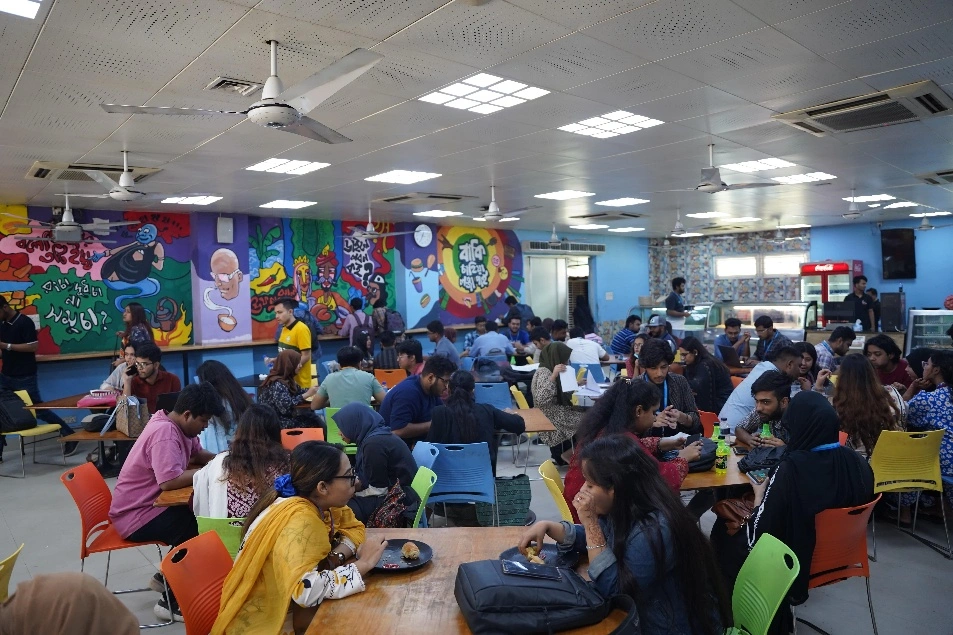
AIUB provides an in-house cafeteria and food carts that offer a variety of food options for students and staff throughout the day, including breakfast, lunch and snacks [20]. These facilities ensure convenient access to food within the university premises, supporting the daily nutritional needs of members of the academic community and providing accessible meal options for those who spend extended periods on campus.
Vegetarian, Vegan and Affordable Food Options
AIUB's campus food outlets offer affordable vegetarian and vegan alternatives, accommodating diverse dietary requirements and preferences within the university community [21]. The availability of plant-based meals encourages dietary diversity and supports more sustainable food consumption practices, while providing students and staff with food choices that consider both nutritional preferences and affordability.
Supporting Local and Sustainable Food Producers
AIUB prioritises locally sourced and sustainable products in its food procurement practices, supporting regional producers and promoting stronger connections between the university and local food supply networks [21]. This approach encourages local sourcing, supports regional agricultural activities and contributes to more sustainable and resilient food systems. By incorporating these considerations into its purchasing decisions, AIUB extends its commitment to food sustainability beyond campus food services.
Sustainable Procurement and Responsible Food Sourcing
AIUB reinforces sustainable food procurement through its institutional Sustainable Procurement Policy, which establishes social, economic and environmental considerations as part of the university's purchasing decisions [22].
The policy guides procurement practices towards the acquisition of organic and locally sourced products whenever possible. It also promotes waste reduction, reusable and refillable packaging, reduced packaging materials and responsible transportation and delivery processes.
These provisions strengthen AIUB's approach to sustainable campus food sourcing by integrating environmental responsibility and support for local producers into its institutional procurement framework [22].
Institutional Support for Students and Staff Experiencing Food Insecurity
AIUB implements institutional support measures to improve access to essential resources and address food insecurity among economically vulnerable members of its university community. Its food assistance initiatives have benefited hundreds of low-income students, while complementary financial support programmes help reduce the economic pressures that can affect access to adequate nutrition [23].
Food Assistance Programmes
AIUB operates food pantries to support students and staff experiencing food insecurity, providing access to essential food supplies within the university community [21]. These initiatives form part of the university's broader welfare framework, which includes free or subsidised essential services such as healthcare and affordable housing for students from low-income families [24].
The university also benefits from the community engagement and fundraising activities of the AIUB Social Welfare Club – Shomoy, which organises food drives and other assistance initiatives for vulnerable communities. These activities complement AIUB's institutional welfare programmes and reinforce its commitment to addressing food insecurity through student participation and community solidarity (see Section 6).
Reducing Financial Barriers to Food Security
AIUB recognises that financial constraints can affect students' ability to meet essential living expenses, including adequate food consumption. To ease these pressures, the university provides need-based tuition waivers and scholarships for students from low-income and underrepresented backgrounds. Additional opportunities, including on-campus part-time employment and volunteer activities with daily allowances for selected events, provide students with further financial support [24], [25].
By reducing education-related expenses and expanding access to financial assistance and income-generating opportunities, AIUB helps economically vulnerable students manage their essential living costs and strengthens the conditions that support their food security.
Knowledge Transfer, Capacity Building and Technology for Farmers and Food Producers
AIUB extends its academic expertise and technological innovations to the agricultural sector by promoting knowledge exchange, practical training and collaboration with farmers, food entrepreneurs and future agribusiness professionals. Its initiatives address sustainable agricultural practices, digital innovation and the adoption of technologies that can strengthen agricultural productivity, improve food supply chains and support rural economic development.
Free Workshops and Access to University Facilities
AIUB provides workshops and seminars on sustainable agriculture for students and local farmers, facilitating access to academic knowledge and technological expertise. The university also shares research-based technologies, including IoT-enabled smart poultry and fish farming systems and potato leaf disease detection methods (see Section 2), through free workshops and access to university facilities [21].
These initiatives promote the practical exchange of knowledge between academia and agricultural stakeholders, enabling farmers to explore innovative approaches to farm management, crop protection and more efficient food production.
Knowledge Exchange on Agriculture and Sustainable Development
In August 2023, AIUB's Department of Economics organised the seminar "Agriculture and its Prospects for Sustainable Development in Bangladesh" as part of the Dr. Anwarul Abedin Lecture Series. The event featured agricultural journalist and activist Shykh Seraj as the keynote speaker, who discussed the evolution of Bangladesh's agricultural sector since independence and its continuing importance for livelihoods, employment and national economic development.
The seminar highlighted the role of technological innovation in addressing agricultural challenges, particularly those associated with climate change, and emphasised the importance of modernising agricultural education to prepare younger generations for technology-driven farming. AIUB's Chairman of the Board of Trustees also underscored the importance of modern agricultural practices in advancing sustainable development [26].
Supporting Local Products and Digital Innovation in Agribusiness
AIUB promotes entrepreneurship and digital innovation as tools for strengthening local businesses and agricultural value chains.
- Digital technologies for agribusiness development. AIUB has also organised activities exploring the application of blockchain technology to agricultural businesses. These initiatives promote awareness of digital solutions that can strengthen agricultural value chains, improve information management and support more transparent business operations [21], [27].
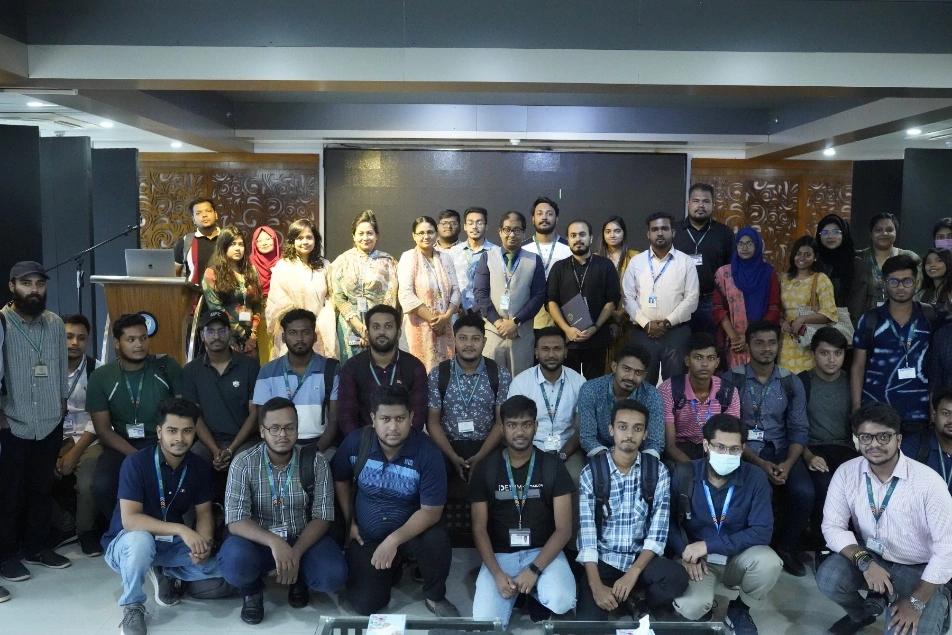
- Workshop on local products and micro, small and medium enterprises (December 2023). Organised by AIUB's Departments of Management Information Systems and Management & HRM, in collaboration with the E-Commerce Development Centre, this two-day workshop introduced students to Bangladesh's locally produced goods and explored opportunities for developing e-commerce businesses around local products. The initiative highlighted the potential of digital platforms to expand market access and support the growth of small enterprises [28].
- Student innovation in blockchain-based agribusiness (April 2026). Approximately 80 BBA students participated in a poster competition presenting innovative applications of blockchain technology in agriculture. Their proposals explored how digital traceability can improve supply chain transparency, strengthen farm-to-market connections, reduce post-harvest losses and empower farmers by improving their access to market information and reducing dependence on intermediaries [29].
Connecting Agricultural Research with Policymakers and Public Institutions
AIUB facilitates knowledge exchange between academic researchers and public institutions responsible for agricultural development, particularly in promoting solar-powered irrigation and climate-resilient farming.
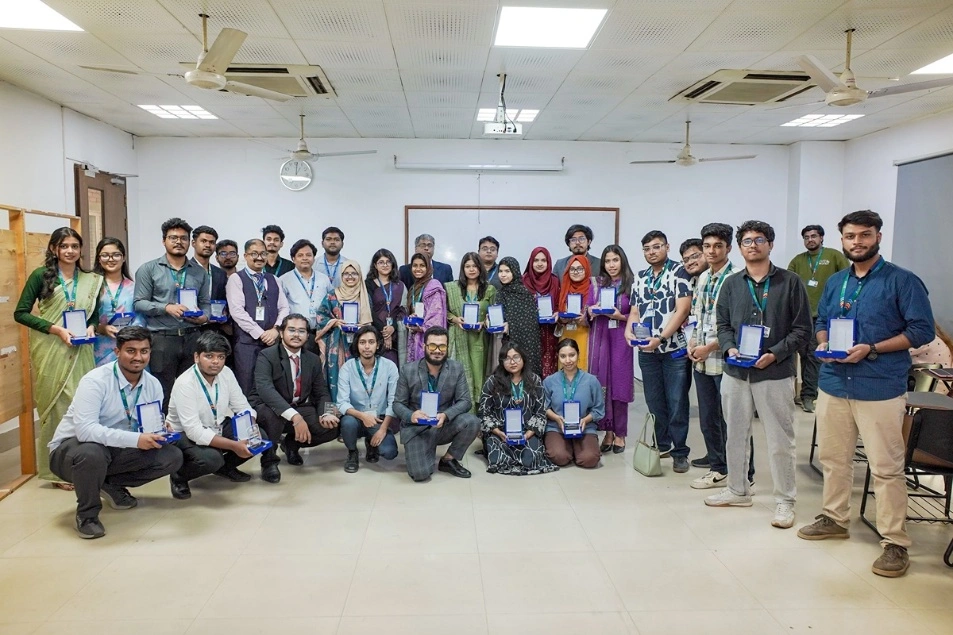
In February 2024, the university participated in a policy engagement workshop on solar irrigation research attended by the Chairman of the Bangladesh Agricultural Development Corporation (BADC) [30]. Subsequently, a dissemination workshop held in December 2024 brought together relevant stakeholders and welcomed the Additional Secretary of the Ministry of Agriculture as Guest of Honour [14], [31].
These engagements strengthen collaboration between academic institutions and agricultural authorities, creating opportunities to share research findings, discuss the adoption of renewable-energy-based irrigation technologies and support the development of more sustainable and climate-resilient agricultural practices.
Technological Innovation for Seed Quality Assessment
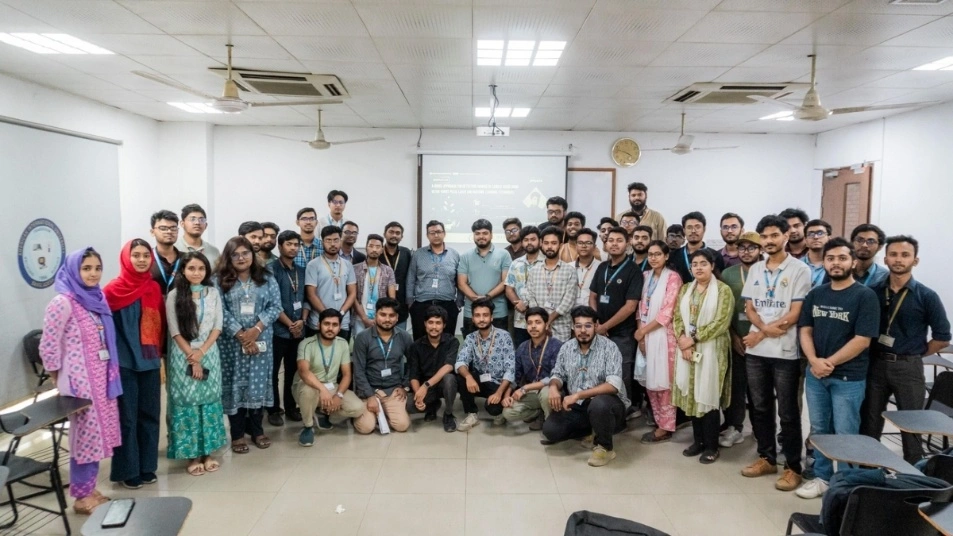
AIUB promotes student engagement with emerging technologies that can contribute to agricultural innovation and food production efficiency.
On March 12, 2025, the IEEE AIUB Student Branch organised a seminar entitled "A Novel Approach for Detecting Damage in Canola Seeds Using Ultra-Short Pulse Laser and Machine Learning Techniques". The event brought together more than 40 participants and featured a keynote presentation by a Graduate Research Assistant from the University of Manitoba [32].
The seminar introduced advanced approaches to seed quality assessment, including ultra-short pulse laser technologies, YOLOv8-based machine learning, Terahertz models and GPU-based computational techniques. Discussions addressed the application of these technologies to seed grading, damage detection and agricultural quality assessment.
The activity strengthened students' understanding of how artificial intelligence and advanced sensing technologies can support agricultural research, improve seed quality assessment and contribute to more efficient food production systems [32].
Community Food Security and Humanitarian Assistance Programmes
AIUB mobilises its students, faculty, administrative staff, alumni and university management to address food insecurity among vulnerable communities across Bangladesh. Through community food drives, seasonal assistance campaigns and emergency relief operations, the university extends its commitment to food security beyond the campus. These initiatives provide essential food supplies to disadvantaged families, support children in vulnerable circumstances and strengthen community resilience during humanitarian emergencies [23].
Emergency Food Assistance During Floods
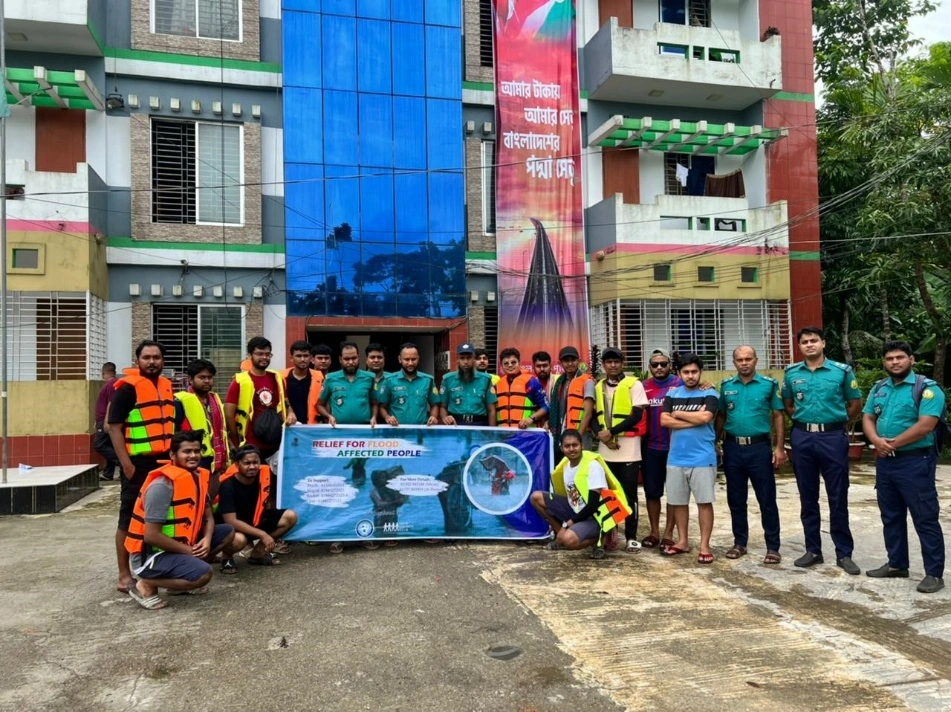
2024 floods. Following the devastating floods that affected south-eastern Bangladesh in 2024, AIUB student organisations mobilised humanitarian assistance for affected communities. Their collective efforts provided essential food and medical supplies to more than 1,200 families. Student volunteers also participated in rescue operations, assisting stranded residents, including children, pregnant women and elderly people. The relief activities brought together contributions from students, alumni, faculty members, administrative staff and university management, demonstrating AIUB's collective commitment to supporting communities affected by natural disasters [33].
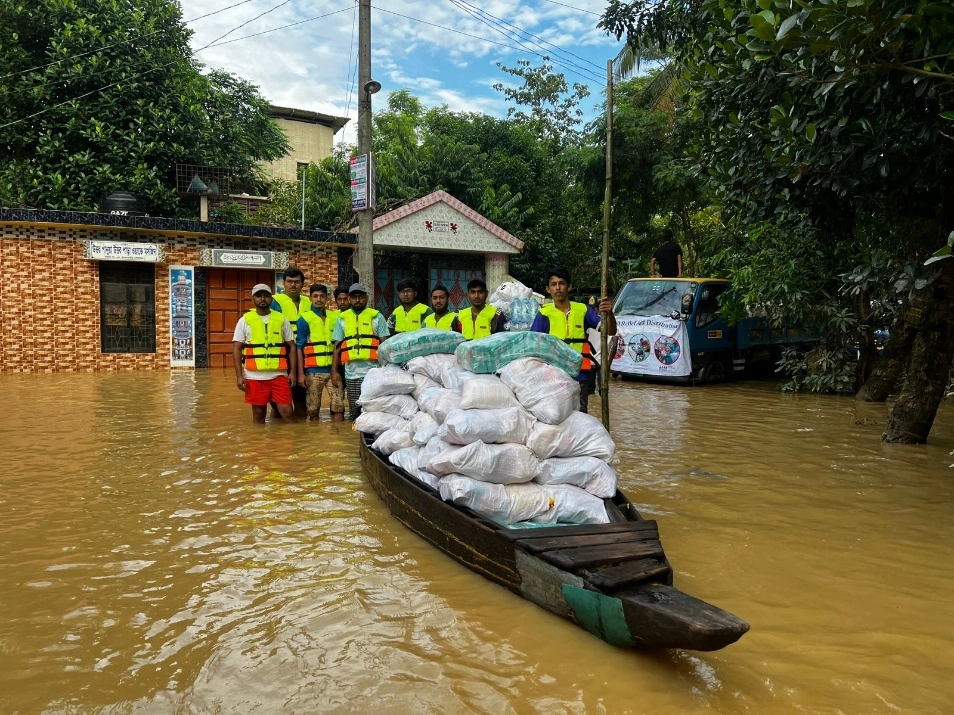
2022 floods. During the severe flash floods that affected the Sylhet division in 2022, the AIUB Social Welfare Club – Shomoy organised a week-long fundraising campaign involving students and university staff. The collected contributions supported the distribution of emergency relief packages containing ready-to-eat food items, including flattened rice, puffed rice, molasses and dates, as well as drinking water, oral rehydration salts and first-aid supplies. This initiative provided essential nutritional support to communities facing disruptions to their daily food supplies during the disaster [34].
"Oder Eid, Amader Khushi" ("Their Eid, Our Joy")
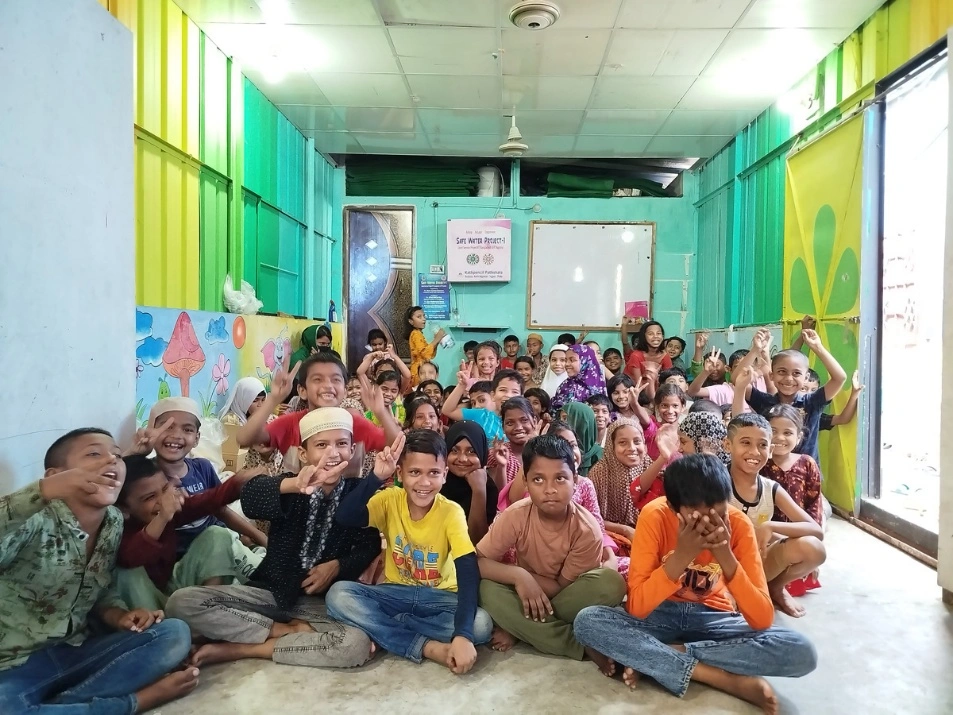
AIUB's Social Welfare Club – Shomoy organises the annual "Oder Eid, Amader Khushi" campaign to share the celebration of Eid with economically disadvantaged families. On April 5, 2024, funds raised within the university community supported the distribution of essential food packages to the families of approximately 150 children enrolled at Kathpencil Pathshala, a school serving underprivileged children where Shomoy members regularly volunteer [35].
The initiative received international recognition when AIUB became the first Asian university featured in the Spotlight series jointly presented by the International Association of Universities (IAU) and Students Organising for Sustainability (SOS-UK). The feature highlighted Shomoy's community engagement activities, including its efforts to provide food, clothing and support to underprivileged children and their families [36].
Free Meals and Education at Kathpencil Pathshala
AIUB supports Kathpencil Pathshala, an educational initiative established by the university's management to serve underprivileged children aged 5–12 who have limited access to formal education. Operating through branches in different locations, the programme is supervised by senior AIUB students and combines free education with comprehensive support for children's essential needs.
In addition to providing free educational materials, Kathpencil Pathshala supplies meals to participating children, helping address food-related barriers to education and supporting their well-being and learning. The programme also incorporates vocational and technical training to develop practical skills that can contribute to future livelihood opportunities. One of its four programme areas, "Crafts for Food and Goods", further connects skills development with the capacity to generate essential resources for daily living [37], [38].
By integrating food provision, education and vocational development, Kathpencil Pathshala represents AIUB's sustained commitment to addressing interconnected dimensions of poverty, food insecurity and social vulnerability among children.
Continued Community Food Assistance: Oder Eid, Amader Khushi 2025
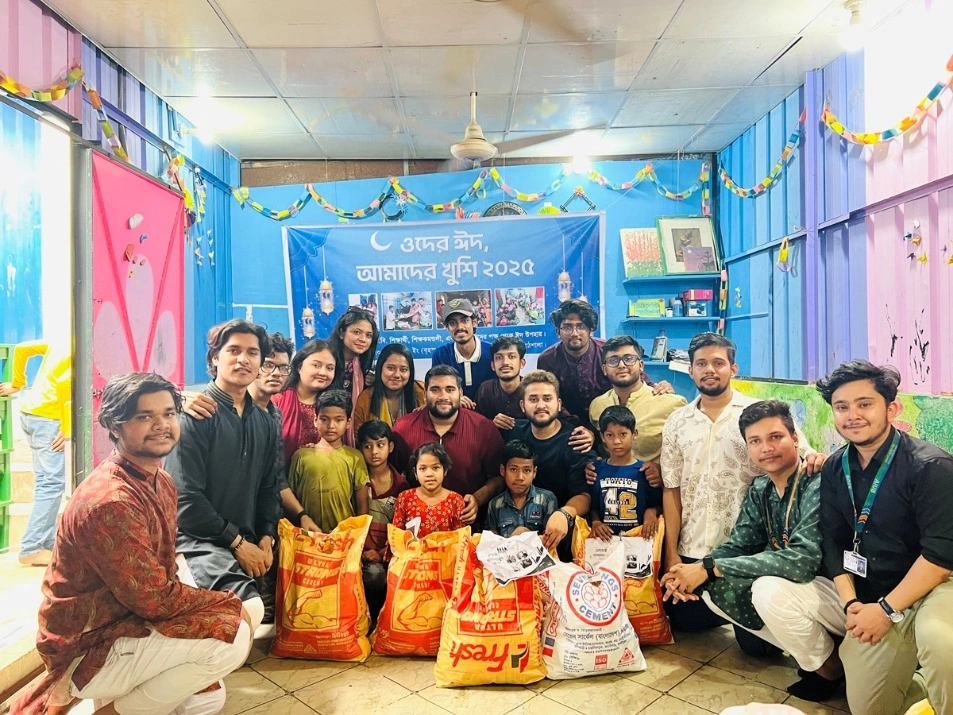
AIUB's commitment to community food security continued in 2025 with another edition of the "Oder Eid, Amader Khushi" campaign organised by the AIUB Social Welfare Club – Shomoy.
On March 20, 2025, the initiative distributed essential food packages to the families of approximately 120 children enrolled at Kathpencil Pathshala in Tejgaon, Dhaka [39].
The campaign involved a week-long fundraising and contribution drive across the university campus, engaging students, faculty members and administrative staff. Shomoy volunteers subsequently prepared food packages containing essential items for distribution to the beneficiary families.
AIUB representatives, faculty mentors and student volunteers participated in the distribution, reinforcing the university community's collective commitment to supporting economically disadvantaged families.
The 2025 campaign demonstrates the continuity of this community food assistance initiative and strengthens AIUB's contribution to improving access to essential food supplies among vulnerable populations [39].
Partnerships and Policy Engagement for Food Security and Sustainable Agriculture
AIUB strengthens its contribution to SDG 2 by engaging with national authorities, international organisations, academic institutions and local communities. These partnerships facilitate the exchange of research knowledge, promote sustainable agricultural practices and encourage collective action to address food security challenges in Bangladesh.
National Policy Engagement on Climate-Smart Irrigation
AIUB actively connects academic research with national agricultural institutions to promote sustainable irrigation practices and strengthen climate resilience in food production.
- Policy Engagement Workshop (February 7, 2024). AIUB hosted a policy engagement workshop marking the launch of stakeholder engagement activities for its solar irrigation research project. The initiative is supported by the World Bank under the Climate Adaptation and Resilience (CARE) programme, in collaboration with the Asian Disaster Preparedness Center (ADPC) [30].
- Research Dissemination and Policy Dialogue Workshop (December 11, 2024). Held at Hotel InterContinental Dhaka, the workshop presented research findings and facilitated discussions on agricultural sustainability, climate change adaptation and the adoption of solar-powered irrigation technologies. The event brought together senior representatives from the Ministry of Agriculture, including the Additional Secretary (PPC Wing) as Guest of Honour, as well as the Vice-Chancellors of AIUB and Khulna University, the Pro-Vice-Chancellor of the University of Rajshahi, and academics from Durham University and Curtin University [14], [31], [40].
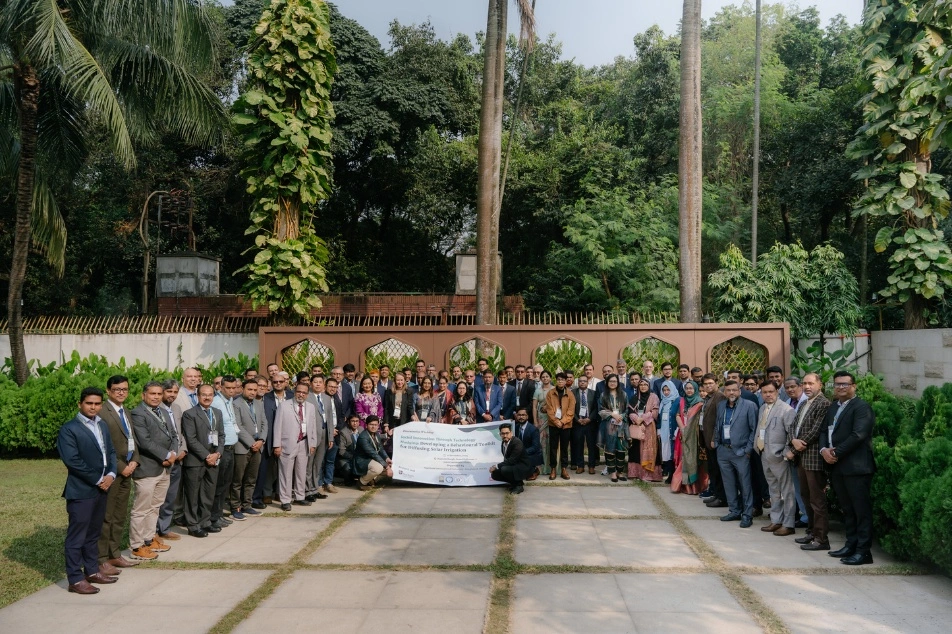
These engagements strengthen collaboration between researchers, policymakers and agricultural institutions, creating opportunities for scientific findings to inform national discussions on renewable-energy-based irrigation, climate adaptation and sustainable agricultural development.
International Commitments and Sustainability Networks
AIUB participates in international initiatives that reinforce its institutional commitment to the Sustainable Development Goals and promote the integration of sustainability into higher education.
- SDG Accord. AIUB is a signatory to the SDG Accord, demonstrating its commitment to contributing to the achievement of the United Nations Sustainable Development Goals by 2030, including SDG 2: Zero Hunger [41].
- Responsible Futures International 2024/25. AIUB became the first and only university from Asia to participate in this international programme, led by Students Organising for Sustainability (SOS-UK) in collaboration with the International Association of Universities (IAU). The initiative promotes the integration of sustainability and climate justice into students' learning experiences, strengthening their awareness of global sustainability challenges and their role in addressing them [42].
- International recognition of student-led food initiatives. AIUB's community food assistance activities were featured in the IAU–SOS Spotlight series, highlighting the university's approach to engaging students in community service and supporting underprivileged families through food and other essential assistance [36].
Together, these commitments and international engagements reinforce AIUB's contribution to sustainability education, community engagement and collective action towards the SDGs.
Experiential Learning on Community Food Security
AIUB connects academic learning with real-world social challenges by providing students with opportunities to engage with communities experiencing socioeconomic vulnerability. Students from the Department of Media and Mass Communication visited the resettlement area of Kumarabhog, Mawa, to explore the living conditions and food security challenges faced by resettled families [23].
This experience exposed students to the socioeconomic dimensions of food insecurity and the challenges faced by communities undergoing resettlement. By connecting academic activities with real community contexts, AIUB encourages greater awareness of food security issues and strengthens students' understanding of the social factors influencing access to adequate food [23].
Regional Collaboration on Nutrition and Anemia Prevention
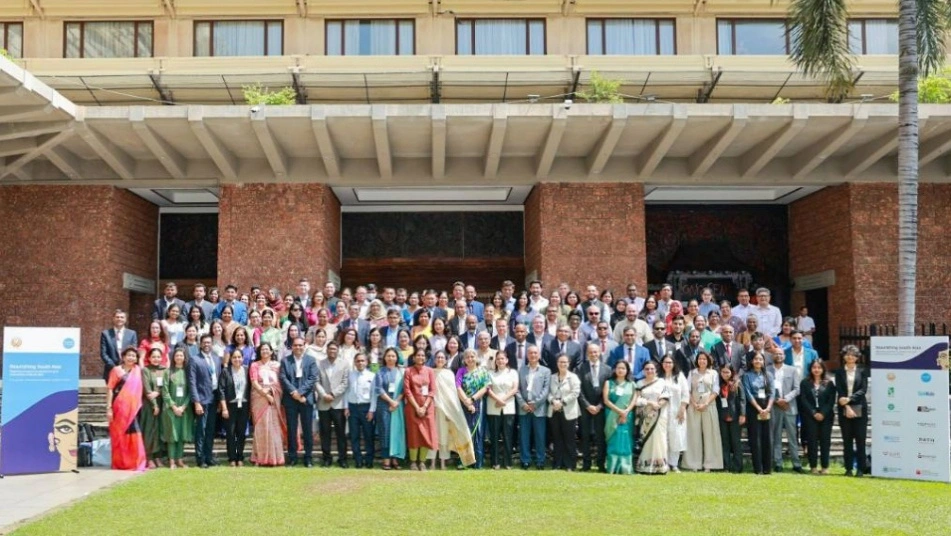
AIUB contributes to regional knowledge exchange and nutrition-related policy discussions through the participation of its academic staff in international health and development initiatives.
In July 2025, Dr. Sabuktagin Rahman, Associate Professor in AIUB's Department of Public Health, represented Bangladesh as an invited speaker at the SAARC Regional Technical Consultation entitled "Nourishing South Asia: Reducing Anemia in Adolescent Girls and Women of South Asia". The consultation was organised by the SAARC Secretariat and UNICEF Regional Office for South Asia from July 9–12, 2025, in Colombo, Sri Lanka [43].
Dr. Rahman facilitated a technical session entitled "Strengthening Knowledge, Measurement, Research and Learning", addressing the interaction between human biology, environmental conditions and programmatic interventions in anemia prevention and control.
He also presented an implementation research plan aimed at strengthening Bangladesh's anemia control programmes over the following five years and highlighted the importance of a comprehensive micronutrient survey to support evidence-based nutritional interventions.
This engagement demonstrates AIUB's contribution to regional academic collaboration, nutrition research and the exchange of knowledge supporting improved nutritional outcomes among vulnerable populations [43].
Public Reporting on SDG 2 Progress (SDG 17.3.2)
AIUB documents and communicates its institutional contributions to Zero Hunger through dedicated public reporting on Sustainable Development Goal 2.
The university published its SDG Activity Report 2023: SDG 2 – Zero Hunger, a dedicated report presenting institutional initiatives, research activities and community engagement related to food security and sustainable agriculture. Covering the university's contributions from 2020 to 2024, the report addresses campus food services, assistance to vulnerable communities, educational initiatives, agricultural research and strategic partnerships [44].
AIUB also maintains a dedicated SDG 2 institutional webpage that presents an overview of its Zero Hunger initiatives and provides public access to the full report [45].
By consolidating its activities and research into a publicly accessible SDG-specific report, AIUB strengthens transparency, institutional accountability and the communication of its progress towards achieving Zero Hunger.
References
| [1] | K. T. Mahmud, A. Parvez, S. S. Ahmed, and F. Rafiq, “Microcredit and the household food security of the fish farmers: evidence from rural Bangladesh,” [Online]. Available: https://doi.org/10.1080/09614524.2022.2101618. [Accessed 2026]. |
| [2] | R. F. Syed, K. T. Mahmud, J. Hossain, and S. Matin, “Reeling in hope: Can fishery credit really improve food expenditure status for poor fish farming communities in rural Bangladesh?,” [Online]. Available: https://dspace.aiub.edu/jspui/handle/123456789/2212. [Accessed 2026]. |
| [3] | S. Haque, F. Rafiq, and K. T. Mahmud, “impact of monthly repayment system on the household income and food expenditure of the rural women borrowers: Evidence from Banglades,” [Online]. Available: https://ajbe.aiub.edu/index.php/ajbe/article/download/114/115/387. [Accessed 2026]. |
| [4] | American International University-Bangladesh, “AIUB SDG Activity Report 2022 | SDG 2: Zero Hunger.,” [Online]. Available: https://www.aiub.edu/iqac/sdgs/aiub-sdg-activity-report-2022/SDG2-AIUBActivityReportof2022. [Accessed 2026]. |
| [5] | R. Basak and K. A. Wahid, “A rapid, low-cost, and high-precision multifrequency electrical impedance tomography data acquisition system for plant phenotyping,” [Online]. Available: https://doi.org/10.3390/rs14133214. [Accessed 2026]. |
| [6] | R. Basak, K. Wahid, and A. Dinh, “Determination of leaf nitrogen concentrations using electrical impedance spectroscopy in multiple crops,” [Online]. Available: https://doi.org/10.3390/rs12030566. [Accessed 2026]. |
| [7] | R. Basak, “Assessment of leaf phosphorus for multiple crop species using an electrical impedance spectroscopy sensor,” [Online]. Available: https://doi.org/10.1109/SAS58821.2023.10254124. [Accessed 2026]. |
| [8] | M. A. Jubaer, M. N. Hasan, M. Mustavi, M. T. Shahriar, and T. Ahmed, “Potato leaf disease detection using image processing,” [Online]. Available: https://www.mecs-press.org/ijeme/ijeme-v13-n4/IJEME-V13-N4-2.pdf. [Accessed 2026]. |
| [9] | American International University-Bangladesh, Faculty of Engineering, “Potato diseases detection using Inception-BiT with explainable AI,” [Online]. Available: https://dspace.aiub.edu/jspui/handle/123456789/2793. [Accessed 2026]. |
| [10] | S. I. Mahbub, S. S. Ratri, S. A. Hamim, and M. H. Bhuyan, “IoT-based smart poultry and fish farming system using Arduino,” [Online]. Available: https://dspace.aiub.edu/jspui/handle/123456789/945. [Accessed 2026]. |
| [11] | M. M. Islam, S. S. Tonmoy, S. Quayum, A. R. Sarker, S. U. Hani, and M. A. Mannan, “Smart poultry farm incorporating GSM and IoT,” [Online]. Available: https://ieeexplore.ieee.org/document/8644464. [Accessed 2026]. |
| [12] | N. Goswami, S. A. Sufian, M. S. Khandakar, K. Z. H. Shihab, and M. S. R. Zishan, “Design and development of smart system for biofloc fish farming in Bangladesh,” [Online]. Available: https://ieeexplore.ieee.org/abstract/document/9835915. [Accessed 2026]. |
| [13] | R. Faiz, N. Alam, M.-E.-E. Prokorso, S. M. R. Islam, S. N. Khan, and M. R. Hoque, “IoT based solar powered automated fish feeding system,” [Online]. Available: https://cigrjournal.org/index.php/Ejounral/article/view/8303. [Accessed 2026]. |
| [14] | American International University-Bangladesh, “AIUB hosts Dissemination Workshop on Solar Irrigation and Climate Adaptation,” [Online]. Available: https://www.aiub.edu/aiub-hosts-dissemination-workshop-on-solar-irrigation-and-climate-adaptation. [Accessed 2026]. |
| [15] | American International University-Bangladesh, “AIUB Faculty Received Research Grant under BAS-USDA Endowment Program,” [Online]. Available: https://www.aiub.edu/aiub-faculty-received-research-grant-under-bas-usda-endowment-program. [Accessed 2026]. |
| [16] | American International University-Bangladesh, “Inception workshop on BAS-USDA research project held at AIUB,” [Online]. Available: https://www.aiub.edu/inception-workshop-on-bas-usda-research-project-held-at-aiub. [Accessed 2026]. |
| [17] | M. I. Piash, M. F. Hossain, and Z. Parveen, “Effect of biochar and fertilizer application on the growth and nutrient accumulation of rice and vegetable in two contrast soils,” [Online]. Available: https://www.researchgate.net/publication/331175781_Effect_of_Biochar_and_Fertilizer_Application_on_the_Growth_and_Nutrient_Accumulation_of_Rice_and_Vegetable_in_Two_Contrast_Soils. [Accessed 2026]. |
| [18] | S. N. Mohammed, S. P. Chaki, S. S. J. Somiya, S. A. Talha, and F. T. Saheli, “Digital Finance for Smallholders: Impacts on Food Security in Bangladesh,” [Online]. Available: https://extension.aiub.edu/Files/student-research/Digital_Finance_for_Smallholders_Impacts_on_Food_Security_in_Bangladesh.html. [Accessed 2026]. |
| [19] | S. A. Haque, T. H. Apurbo, S. Islam, and M. A. S. Farhan, “An Explainable Machine Learning Framework for Food Waste Management and Sustainable Consumption,” [Online]. Available: https://intranet.aiub.edu/Files/student-research/An_Explainable_Machine_Learning_Framework_for_Food_Waste_Management_and_Sustainable_Consumption.html. [Accessed 2026]. |
| [20] | American International University-Bangladesh, “Cafeteria,” [Online]. Available: https://aiub.edu/oncampus/cafeteria. [Accessed 2026]. |
| [21] | American International University-Bangladesh, “AIUB SDG Activity Report 2023 | SDG 2: Zero Hunger,” [Online]. Available: https://www.aiub.edu/iqac/sdgs/aiub-sdg-activity-report-2023/SDG2-AIUBActivityReportof2023. [Accessed 2026]. |
| [22] | American International University-Bangladesh, “Sustainable Procurement Policy of AIUB.,” [Online]. Available: https://www.aiub.edu/administration/institutional-policy/sustainable-procurement-policy-of-aiub. [Accessed 2026]. |
| [23] | American International University-Bangladesh, “SDG 2: Zero Hunger,” [Online]. Available: https://aiub.edu/sustainability/sdg2. [Accessed 2026]. |
| [24] | American International University-Bangladesh, “Low-income Student Support,” [Online]. Available: https://aiub.edu/sustainability/sdg1/initiative/low-income-student-support. [Accessed 2026]. |
| [25] | American International University-Bangladesh, “Scholarship (tuition fee waiver only) and Financial Aid Policy,” [Online]. Available: https://www.aiub.edu/admission/scholarships. [Accessed 2026]. |
| [26] | Dhaka Tribune, “AIUB organized seminar on agriculture for sustainable development in Bangladesh,” [Online]. Available: https://www.dhakatribune.com/bangladesh/education/322652/aiub. [Accessed 2026]. |
| [27] | American International University-Bangladesh, “Empowering Agribusiness with Blockchain Technologies,” [Online]. Available: https://www.aiub.edu/empowering-agribusiness-with-blockchain-technologies. [Accessed 2026]. |
| [28] | American International University-Bangladesh, “Workshop on ‘Prospects of the local products for Micro, Small & Medium Enterprises in Bangladesh’,” [Online]. Available: https://www.aiub.edu/workshop-on-prospects-of-the-local-products-for-micro-small--medium-enterprises-in-bangladesh. [Accessed 2026]. |
| [29] | American International University-Bangladesh, “Poster Contest: Value Addition through Blockchain in Agro Business,” [Online]. Available: https://aiub.edu/poster-contestvalue-addition-through-blockchain-in-agro-business-. [Accessed 2026]. |
| [30] | American International University-Bangladesh, “Policy Engagement Workshop on collaborative research — 'Social Innovation Through Technology Nudging: Developing a Behavioral Toolkit for Diffusing Solar Irrigation',” [Online]. Available: https://www.aiub.edu/policy-engagement-workshop-on-collaborative-research---social-innovation-through-technology-nudging-developing-a-behavioral-toolkit-for-diffusing-solar-irrigation. [Accessed 2026]. |
| [31] | Dhaka Tribune, “AIUB Hosts Dissemination Workshop on Solar Irrigation and Climate Adaptation,” [Online]. Available: https://www.dhakatribune.com/bangladesh/education/368162/aiub-hosts-dissemination-workshop-on-solar. [Accessed 2026]. |
| [32] | American International University-Bangladesh, “Seminar on a Novel Approach for Detecting Damage in Canola Seeds Using Ultra-Short Pulse Laser and Machine Learning Techniques,” [Online]. Available: https://www.aiub.edu/seminar-on-a-novel-approach-for-detecting-damage-in-canola-seeds-using-ultra-short-pulse-laser-and-machine-learning-techniques. [Accessed 2026]. |
| [33] | American International University-Bangladesh, “Students of AIUB: Standing with the Flood-Effected,” [Online]. Available: https://www.aiub.edu/students-of-aiub-standing-with-the-flood-effected. [Accessed 2026]. |
| [34] | American International University-Bangladesh, “AIUB Social Welfare Club — 'Shomoy': 'Standing with the Flood-Effected 2022',” [Online]. Available: https://www.aiub.edu/aiub-social-welfare-club--shomoy-standing-with-the-flood-effected-2022. [Accessed 2026]. |
| [35] | American International University-Bangladesh, “'Oder Eid, Amader Khushi' by the AIUB Social Welfare Club – Shomoy,” [Online]. Available: https://www.aiub.edu/oder-eid-amader-khushi-by-the-aiub-social-welfare-club---shomoy. [Accessed 2026]. |
| [36] | The Financial Express, “AIUB becomes first Asian university to be featured in IAU-SOS Spotlight,” [Online]. Available: https://thefinancialexpress.com.bd/education/aiub-becomes-first-asian-university-to-be-featured-in-iau-sos-spotlight. [Accessed 2026]. |
| [37] | American International University-Bangladesh, “Activities of AIUB in the wider community,” [Online]. Available: https://www.aiub.edu/iqac/sdgs/aiub-sdg-activity-report-2023/sdg17-aiubactivityreportof2023/sdg-initiative/activities-of-aiub-in-the-wider-community. [Accessed 2026]. |
| [38] | American International University-Bangladesh, “Programmes for Services Access,” [Online]. Available: https://aiub.edu/sustainability/sdg1/initiative/programmes-for-services-access. [Accessed 2026]. |
| [39] | American International University-Bangladesh, “AIUB Social Welfare Club – Shomoy Successfully Organizes 'Oder Eid, Amader Khushi 2025',” [Online]. Available: https://www.aiub.edu/aiub-social-welfare-club--shomoy-successfully-organizes--oder-eid-amader-khushi-2025. [Accessed 2026]. |
| [40] | The Daily Messenger, “AIUB hosts dissemination workshop on solar irrigation and climate adaptation,” [Online]. Available: https://dailymessenger.net/business/news/29637. [Accessed 2026]. |
| [41] | American International University-Bangladesh, “AIUB is a Signatory of SDG Accord,” [Online]. Available: https://www.aiub.edu/iqac/sdgs/aiub-is-a-signatory-of-sdg-accord. [Accessed 2026]. |
| [42] | American International University-Bangladesh, “AIUB Joins 'Responsible Futures International 2024/25',” [Online]. Available: https://aiub.edu/aiub-joins-responsible-futures-international-2024-2025. [Accessed 2026]. |
| [43] | American International University-Bangladesh, “Dr Sabuktagin Rahman attended the SAARC Regional Technical Consultation on Anemia,” [Online]. Available: https://www.aiub.edu/dr-sabuktagin-rahman-attended-the-saarc-regional-technical-consultation-on-anemia. [Accessed 2026]. |
| [44] | American International University-Bangladesh, “SDG Activity Report 2023: SDG 2 – Zero Hunger,” [Online]. Available: https://www.aiub.edu/Files/Uploads/sdg-2-activity-report-2023.pdf. [Accessed 2026]. |
| [45] | American International University-Bangladesh, “SDG 2: Zero Hunger,” [Online]. Available: https://www.aiub.edu/sustainability/sdg2. [Accessed 2026]. |